A Wedding, Facebook Photos and the $124 Million Judgment Against the Port of Lake Charles

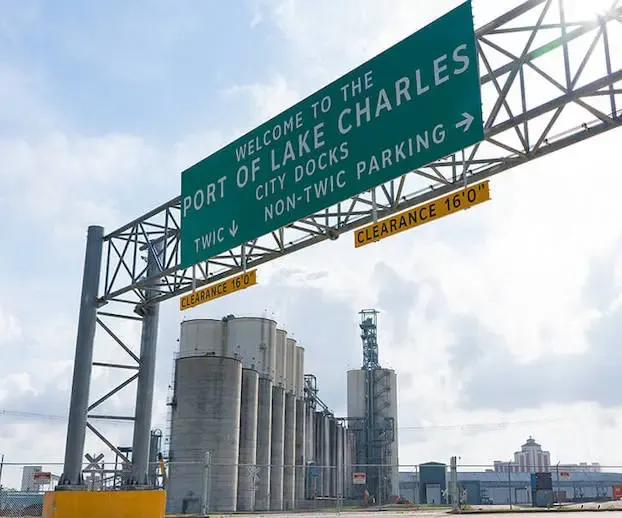
The lawsuit began at Berth 8, where Contraband Bayou meets the ship channel. IFG Port Holdings had finished building a grain terminal, but the water alongside the berth was too shallow for the company to make full use of the terminal. The lease called for IFG to arrange the dredging. It left one central question unanswered. Who had to get the permit from the Army Corps of Engineers?
Both sides agreed in 2017 to let U.S. Magistrate Judge Kathleen Kay decide the case without a jury.
William B. “Bill” Monk, IFG’s lead trial lawyer, is a longtime Lake Charles commercial and oil-and-gas litigator with Stockwell, Sievert, Viccellio, Clements & Shaddock, the city’s oldest and largest law firm. Monk was admitted to the Louisiana bar in 1981 and had been close friends with Kay and her family since the mid-1980s. He stood as a groomsman in her wedding. Three months before IFG filed suit, Kay officiated the wedding of Monk’s daughter Lucie.
Before the parties consented to Kay’s authority, she disclosed that Monk’s other daughter, Margaret, worked as her law clerk and would be kept off the case. Her disclosure left out a close personal friendship spanning nearly forty years.
The Port’s Own Lawyers Initially Praised Her—Before Getting Obliterated
In an internal email uncovered during discovery, one of the Port’s lawyers praised Kay after an early hearing. “The way Magistrate Judge Kay got to the bottom of the issues the other day impressed all of us. It appeared she had read everything and was completely prepared not to put up with IFG’s hyperbole and B.S.”
Then came the 20-day trial. Kay awarded IFG $124,531,652, including treble damages under Louisiana’s unfair trade practices law. Her written ruling sharply criticized the Port and its attorneys, describing the public agency’s conduct as “extortionary,” “sanctimonious,” and “nefarious” and accusing its lawyers of “stunning” hubris.
The Port’s legal team began investigating.
The Evidence Was Sitting on Facebook
Publicly available photographs showed Monk at Kay’s wedding and Kay officiating Lucie’s. Those photographs became evidence in the Port’s challenge to the judgment. The families attended dinners and social events together. The Monks once took Kay’s son on a family vacation. Kay and Monk also exchanged texts and Facebook messages over the years.
The question was no longer simply whether the Port had breached its obligations to IFG. It was whether the Port understood the extent of Kay’s friendship with the opposing attorney when it agreed to let her decide the case.
A Federal Judge From Texas, a Louisiana Judge on the Witness Stand
U.S. District Judge Michael J. Truncale of Beaumont, Texas, was assigned to examine the dispute.
In April 2024, Truncale held a four-day evidentiary hearing. Kay and Monk testified under oath about their nearly 40-year friendship. Kay testified that it had not occurred to her to disclose more.
IFG argued that the Port must have known about the friendship because some of its local lawyers were Facebook friends with Kay and occasionally liked or commented on her posts.
After hearing the testimony, Truncale concluded that the Port had not been adequately informed before agreeing to Kay’s authority. He set aside the $124.5 million judgment.
Appellate Battles and a Case Still Unresolved
On September 8, 2026, a divided Fifth Circuit panel upheld Truncale’s decision. A dissenting judge warned that allowing parties to investigate judges after losing could encourage challenges motivated by unfavorable rulings. Subsequent appellate filings have continued to challenge the panel’s reasoning.
The Port’s original lead trial attorney, William J. “Joe” Mize, died in 2021. His son and co-counsel, Matt Mize, carried on the fight over what his father knew when he signed the consent form in 2017.
The underlying dredging lawsuit remains unresolved. For the Port of Lake Charles, the case raises a question that extends beyond the ship channel. How much must a judge disclose before the people appearing in court can knowingly agree to let that judge decide their case?
Sources U.S. Court of Appeals for the Fifth Circuit, Case No. 24-30552 (September 8, 2026 opinion and subsequent appellate filings). U.S. District Court for the Western District of Louisiana, Case No. 2:16-cv-00146.