McNeese Found a New Species in Lake Charles. They Named It “Lagniappe.”

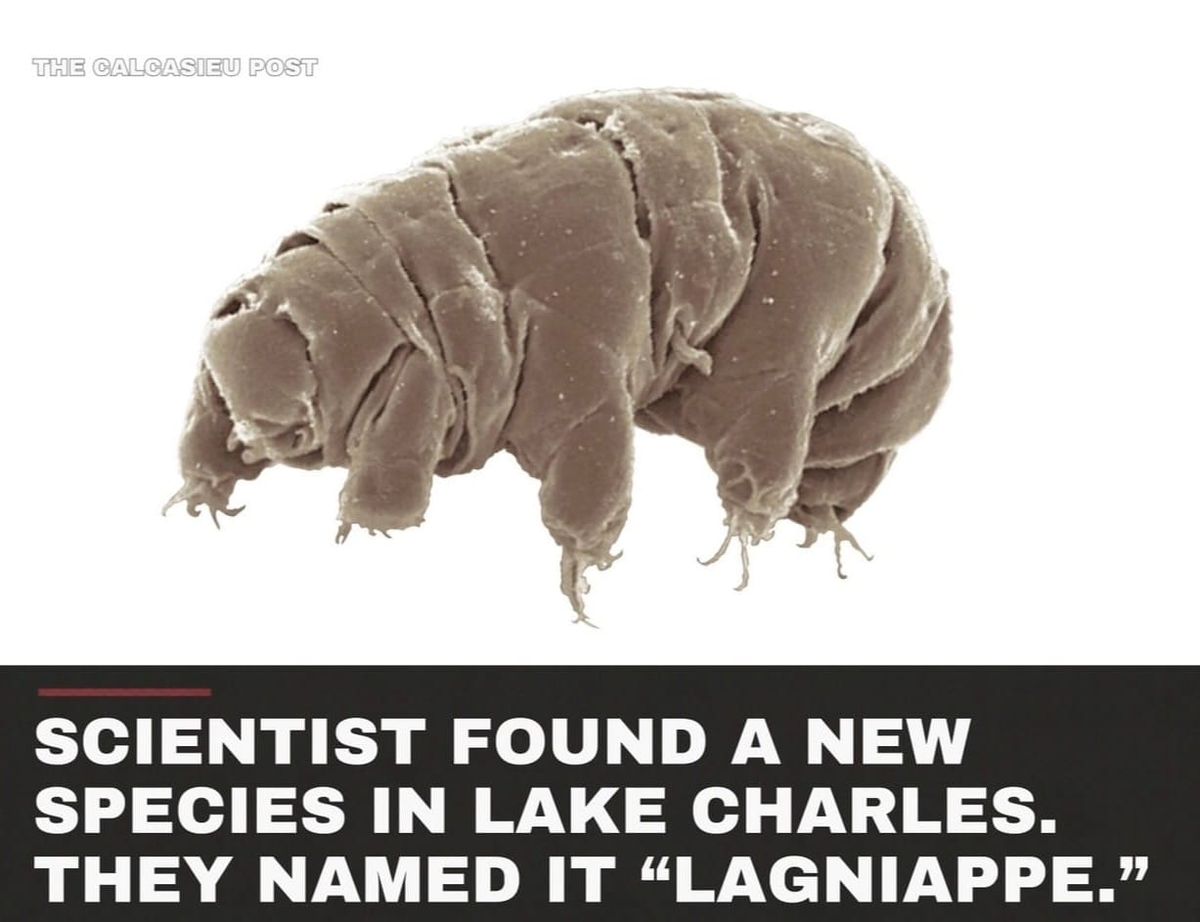
McNeese researchers were studying the microscopic animals living around Lake Charles when they found one that did not fit the scientific descriptions already on record.
It came from samples collected along River Road and at Sam Houston Jones State Park. The researchers named it Milnesium lagniappe—a Louisiana name for an unexpected discovery.
Harry A. Meyer, Juliana G. Hinton and Maria C. Dupré formally described the species in a 2013 paper. Their work placed familiar Calcasieu locations in the scientific record as collection sites for a previously undescribed animal.
At the state park, specimens came from the Blue, Yellow and River Walk trails. Researchers collected lichen from trees, moss and fallen leaves during 2011 and 2012, then examined the tiny animals recovered from those samples.
Among them was the water bear that would become “lagniappe.”
Its identity came down to details visible under a microscope: nine patterned bands across its back and sides, and a distinctive arrangement of points on its claws. Those features helped distinguish it from species scientists already knew.
The name reflected how the discovery happened. The team had been conducting an urban ecology study, not a search for this particular animal. In their paper, they defined “lagniappe” as an “unexpected benefit.”
The finding also reached beyond Louisiana. Specimens collected in Florida had previously been identified as a different species. The researchers determined those animals were Milnesium lagniappe, too.
A discovery made through samples from Calcasieu gave scientists a way to recognize an animal they had already encountered elsewhere—but had not correctly identified.
Source: Meyer, Hinton and Dupré, Western North American Naturalist, 2013, pages 295–301.